PCOS Is Now PMOS: Symptoms, Causes & Support
September 7, 2026
PCOS has a new name: polyendocrine metabolic ovarian syndrome, or PMOS. Registered dietitians Melanie Beasley and Britni Vincent explain what the new name reveals about this complex hormonal and metabolic condition, including common symptoms, insulin resistance, irregular cycles, and fertility challenges. Learn how real-food nutrition and lifestyle changes can support blood sugar, metabolic health, and better symptom management.
Listen below, or subscribe to our podcasts through Apple Podcast or Spotify.
Join our Dishing Up Nutrition Facebook Community!
A private, supportive space to ask questions, share ideas, and get bonus content from our nutrition team.
Similar Podcast Episodes
Similar Articles
Transcript
Melanie: Welcome to Dishing Up Nutrition, brought to you by Nutritional Weigh & Wellness. I'm Melanie Beasley, a Registered and Licensed Dietitian. I'm here with Britni Vincent, also Registered and Licensed Dietitian. And today we're talking about a condition that affects 170 million women worldwide. And a lot of women may have it without even realizing it. And we are talking about PCOS, except as of 2026, PCOS has a new name.
Britni: It sure does.
Melanie: We can't keep track of all these things.
Britni: Uh, no, that's why you have us. And you mentioned how many women it affects. I also wanted to mention that it is the number one cause of infertility in women. And it accounts for 70 to 80% of cases because of anovulation, which means that a woman is not ovulating.
So this is affecting a lot of women, and like you've said, a lot of people don't even know that they have it. And, you know, PCOS, people are used to hearing that, so it's going to be a little bit of a change. PCOS is known as polycystic ovarian syndrome. So now it is called polyendocrine metabolic ovarian syndrome or PMOS.
Melanie: PMOS. And that name change gives us a good starting point for today's conversation because it helps explain something really important. This condition is about much more than just your ovaries.
Britni: It sure is. So we're going to break down what PMOS is, why they even changed the name, and how diet can help. I mean, I work with a lot of women with formerly PCOS, and it's amazing how much influence diet and lifestyle can, can have. I mean, I've seen women get pregnant. I've seen women begin to ovulate again, just see improvement in their overall symptoms. And we're going to dive into what those symptoms could be. So it really makes a huge, huge impact.
Why has the name changed from PCOS to PMOS?
Melanie: So tell us a little bit about why change the name.
Britni: So again, the new name, I will repeat it, Polyendocrine Metabolic Ovarian Syndrome. So the name change really, I think, is meant to better reflect how it affects the entire body. And hopefully, you know, with this name change, more women will get diagnosed because, you know, it affects everybody very differently. It's not very straightforward.
And I do want to mention, it doesn't mean that the condition changed. It's the same. It's just a new name because our understanding of this condition has really evolved over the years. And again, I think the, the new name better reflects this new information that we have about it.
Melanie: Because it's really a syndrome. It's not just an ovary problem.
Britni: Mm-hmm.
Melanie: And because the old name polycystic ovarian syndrome made it sound like it was only a problem of ovarian cysts.
Britni: Yeah, exactly. And I think it, that's very misleading. So, you know, the structures that are sometimes seen on an ultrasound in people with PMOS aren't necessarily abnormal ovarian cysts in the way that many people might think of it. They're often follicles that have stopped developing. And, and even more importantly, you can have PMOS without having that ovarian appearance at, at all.
Melanie: That's really huge.
Britni: It is huge. And having ovarian cysts has never been part of the official diagnosis, but I think unfortunately in the medical community, women that don't have that piece have kind of, they've said, "All right, well, it must not be PCOS. It must be something else."
Melanie: If you don't have those little string of pearls.
Britni: Yep.
Melanie: And what I love about the new name is it describes how it's a syndrome over the whole body. So it, it, because imagine being told, "You don't have cysts, so you can't have PCOS."
Britni: Mm-hmm.
Melanie: That would be really, really frustrating because there's so much more that goes into it.
Britni: Yeah, exactly. And, and I think a lot of people are just looking for answers to what's going on in their body. And, you know, I think it's really helpful to have a diagnosis sometimes so you can move forward and understand internally what's actually going on.
Melanie: Mm-hmm.
Britni: And unfortunately, women who haven't fit the stereotypical picture of PCOS, now PMOS, they just get overlooked. So, I think that misunderstanding has really been a part of the problem because the reality is it's a complex hormonal and metabolic condition.
So it can involve androgen levels, insulin resistance, lack of ovulation. It impacts your menstrual cycles, fertility, skin, hair, metabolic health. I mean, more. It can affect a lot of areas of the body. So this new day. So this new name, it just gives us a lot broader picture. So breaking down the name, polyendocrine, that tells us that multiple hormonal systems can be involved.
Poly meaning multiple, endocrine means hormones. Metabolic acknowledges that the metabolic side of the condition, so including insulin resistance and increased risk for a condition like type two diabetes. Ovarian does recognize the reproductive and the ovarian component. And then syndrome reminds us that we are talking…
Melanie: It's that collection of symptoms that don't exactly look the same in every person.
Britni: Exactly. Yep.
Melanie: So, and this wasn't just a handful of doctors deciding one day that they wanted a new acronym.
Britni: No, this was a big process.
Melanie: They're busy. They're not just looking for different names.
Britni: For sure. The effort involved 56 professional organizations, more than 22,000 survey responses. So the new terminology, I think it just opens up really valuable conversation. And again, it does not mean that the condition itself changes at all, and it does not change how it's diagnosed. And I though it would be helpful to include how it is actually diagnosed.
Melanie: Mm-hmm.
Britni: Unfortunately, this is not the process that every medical professional uses, but generally diagnosis of PMOS is based on something called the Rotterdam criteria. So if you are diagnosed, you will fit at least two of the three criteria.
And the criteria are having ovulatory dysfunction, hyperandrogenism, meaning elevated androgens, and polycystic ovarian morphology, meaning, again, you might have cysts on your ovaries. So if you fit two of those three criteria, that is kind of the gold standard of how it's diagnosed.
What causes PMOS?
Melanie: Let's get into the question everybody wants answered. What causes it and how does it develop? You know, and this is one of those frustrating answers that we're going to give you. We don't know one single cause. There isn't just one factor or one specific event that causes PMOS. You know, I always think most disease processes are not from one single factor. Heart disease is not because you have one elevated number, right?
Britni: Agreed. Yeah.
Melanie: So current evidence suggests that genetic and environmental factors both contribute. And hormones and metabolism interact in ways that can create and reinforce the symptoms. So let's unpack that starting with genetics, because that's one we can't control.
Britni: Mm-hmm. We know that PMOS tends to run in families. So researchers have identified some genetic variants associated with the condition. But again, genetics are not the entire story. This is really multifactorial, and you can think of it more as a predisposition.
So someone may inherit biological characteristics that make PMOS more likely to develop, but that does not mean that it's going to become your, your reality because the other factors, your lifestyle, your environment, are going to play a huge role into if it shows up and how strongly, what, what type of symptoms.
Melanie: Yeah. So which probably helps explain why two sisters could both have PMOS.
Britni: Uh-huh.
Melanie: But have completely different symptoms.
Britni: Yep, exactly. So one's person's biggest concern might be irregular periods. Others may have more of those androgenic symptoms, which could be acne and facial hair. Someone else might not have any noticeable outward symptoms. So again, there isn't one universal PMOS experience.
What is insulin resistance & how does it relate to PMOS?
Melanie: That's a good way to explain it. So let's talk about insulin resistance first, because that term comes up constantly with PMOS. What does it actually mean? Insulin is a hormone that helps move glucose from our bloodstream into our cells, where it can be used for energy. Imagine insulin as a messenger saying, "Hey, there's fuel out here in the bloodstream. Let's get it into the cell."
And with insulin resistance, the cells aren't responding. They're the, they're the spoiled child that just won't respond to the message. And so that signal is not getting used efficiently. And so the body may compensate by producing more insulin. And what happens when insulin stays high?
Britni: Well, when other cells in the body become insulin resistant, your ovaries remain relatively insulin sensitive. So your ovaries are just getting bombarded with insulin, which can cause an increase in androgen production. And androgens, you know, we typically think of those as hormones that are higher in men.
Melanie: Mm-hmm.
Britni: Like testosterone and DHEA, but women have them too. And women with PMOS commonly have increased levels. So those elevated androgens, they can interfere with normal follicle development and ovulation. In fact, what appear as cysts on some ultrasounds may actually just be immature follicles, which are a sign of hormonal dysfunction.
So you can get this interconnected cycle involving insulin, androgens, ovulation, and then if androgens are elevated, that can exacerbate or cause insulin resistance itself. So elevated androgens, they're going to impair how insulin is signaled in your muscles. And elevated androgens will also promote more visceral fat, more fat around those organs.
Yep. And if you have visceral fat, it is metabolically active, which creates more inflammation and that visceral fat can increase or exacerbate that insulin resistance. So you can see it's a cycle that can happen in the body and the elevated androgens and the high insulin. They kind of feed off of each other.
Melanie: Mm-hmm. So would you say they have difficulty losing weight?
Britni: Yeah. A lot of women do, for sure.
Melanie: Yeah. That helps explain why symptoms that seem completely unrelated can actually belong to the same system of conditions. And like acne, facial hair, missing periods, they all seem disconnected, but they're all part of a syndrome.
Britni: Exactly. Yeah. So, you know, some people might think my periods are irregular. All of a sudden I have coarse hairs on my chin, my acne won't go away. I have unexplained weight gain or difficulty losing weight. I mean, those issues may seem like five separate concerns, but again, with PMOS, they're all connected and they're explained through the hormonal and metabolic systems that are involved in this condition.
Melanie: So this can also make someone have difficulty getting pregnant.
Britni: For sure.
Melanie: Okay.
Britni: Yes.
Melanie: And, and we should emphasize that not everyone with PMOS is overweight, Britni. You're a very slender woman. And you had PMOS.
Britni: Mm-hmm.
Melanie: And you also, no difficulty getting pregnant.
Britni: Yeah. So, you know, my journey was kind of interesting, because I did have a regular cycle, about 28 days, but I didn't realize that I was never ovulating.
Melanie: Ah.
Britni: So I had some lab tests done that showed my progesterone was very low. And if your progesterone is really low back at the luteal phase of your cycle, the, the time of your cycle after ovulation, if your progesterone is really low, that means you didn't ovulate, because ovulation is going to signal a surge of progesterone.
And then I had higher DHEA, higher testosterone, all of that. And the original doctor I saw said, "Well, you're not ovulating, but that's not a big deal. When you want to get pregnant, we'll just give you medication."
Melanie: Yikes.
Britni: Right? I was not happy with that answer. So, I found somebody else who took a different approach and through, yeah, lifestyle changes, some key supplements, I started ovulating. My DHEA went down, my testosterone normalized.
Melanie: This is fantastic.
Britni: And my goal was, I really wanted to figure this out before I wanted to get pregnant. So then when the time came, it wasn't this hurdle.
Melanie: Were you having insulin resistance?
Britni: My insulin was never very high. And so anyway, by the time we wanted to have kids, we were able to, and now I have three children. And so I, it, it is absolutely doable, through lifestyle, diet changes, and every woman, this looks different for every woman. What those modifications might be is going to vary from person to person, but it's doable. And if you don't like the answer that one medical professional tells you, find somebody else that supports you.
Melanie: And make an appointment with Britni.
Britni: Yeah. I am happy to help. You know, I had somebody else try to argue with me that I didn't have it, because I did not fit the stereotypical what people think of as PCOS. So be your own advocate.
Melanie: You really did the hard work.
Britni: Yeah, you have to be your own advocate. And find somebody that is willing to listen and dig in, and then you can make those changes.
Melanie: So really, the simplified version is there's no single known cause. Genetics appear to matter, but huge environmental and biological factors matter. And you're a testimony to that. And hormonal regulation, that matters.
Britni: Mm-hmm.
Melanie: And insulin resistance plays an important role for many people. And putting it all together, gosh, it's so confusing.
Britni: It is confusing. And that insulin resistance is a very important piece of the puzzle. And I've also often thought, by the time I got diagnosed, I had already made a lot of changes. So it's quite possible I had already reversed some of that insulin resistance through those changes.
But it, it's also possible not every woman with PMOS has insulin resistance. So I also want to point out that it's not something that you did wrong. You didn't give yourself PMOS because you ate the wrong diet. That is not at all what we want people to think. But, you know, nutrition, like we've been saying, can be a very important tool for managing symptoms and in supporting your metabolic health.
1st signs of PMOS (#1: irregular menstrual cycles)
Melanie: Yeah, I agree. So what are the first signs of PMOS? Let's say somebody's listening and wondering, "Gosh, some of this sounds like me."
Britni: Mm-hmm.
Melanie: What would some of those first signs be?
Britni: I mean, I think one of the biggest clues, and especially when I'm working with people, this is always a question I'm asking are, "What is your cycle length? How frequently are you getting your period?" And if you have irregular cycles, that can be a big sign.
And that, what that means is your periods are very far apart. They could be skipped completely. I mean, some women don't have a period for six months. And then some women can experience very heavy bleeding when they do end up having one. So that would be, like one very big clue.
Melanie: Irregular periods, very heavy bleeding when they do have their periods.
Britni: Mm-hmm.
Melanie: That's good. We will be right back after a message from our sponsors.
Britni: Welcome back to Dishing Up Nutrition. We are here today talking about the fact that PCOS has a new name called PMOS. And before the break, we were talking about how irregular periods can be a big clue that PMOS could be going on. So I just want to add this, that cycles shorter than 21 days and longer than 35 days are typically anovulatory cycles, meaning that you are not ovulating.
Melanie: Okay.
Britni: So that can be a big clue. And for most women with PMOS, they're not having short cycles. They're having long cycles. And again, that could be potentially confirmed, you know, let's say if your cycle is 30 to 35 days and you want to see if you are ovulating, you could get your progesterone tested in that luteal phase of your cycle. That is the phase right before you get your period, and that could help to confirm whether or not you're ovulating.
#2: acne
Melanie: That's good information. You know, another symptom would be acne, sometimes severe, appears, you know, even past your typical teenage years or doesn't respond well to typical treatments.
#3: abnormal hair growth or thinning
And then there's hair growth, which you can get some hair growth, you know, on the chin. It's sort of that coarse hair that you're like, "What in the world is going on here?"
Britni: Mm-hmm.
Melanie: That could be a sign.
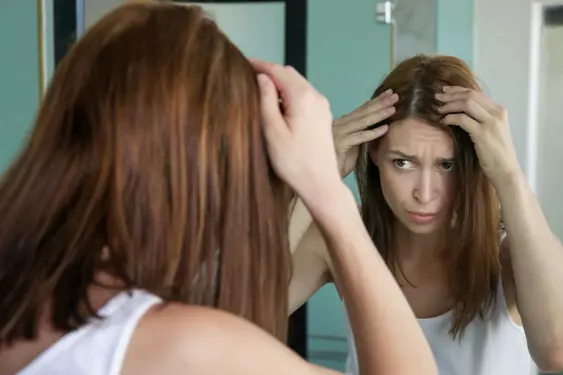
Britni: Yeah. And that's because of those elevated androgens. So that can lead to hirsutism, which means increased coarse hair growth, face, chin, chest, abdomen, thighs. At the same time, those elevated androgens can cause some women to experience hair thinning on the scalp.
Melanie: Ugh. When you're a woman, this is so frustrating. Yeah. And it feels, it really feels unfair, you know? That's just so unfair.
#4: difficulty with weight management
Britni: Yeah. It can be extremely distressing. And the changes in hair, skin, of course, that can have a big effect on confidence, you know, quality of life. And other possible signs could be difficulty with weight management, particularly increased weight around the waist or other signs associated with insulin resistance.
#5: difficulty becoming pregnant
And for some people, you know, one of the first clues isn't obvious until they start to, to try to become pregnant.
Melanie: Because they're not ovulating regularly. If ovulation isn't occurring regularly, getting pregnant can become more difficult. And that's unfortunately when some people finally receive a diagnosis. So we don't want women waiting until fertility becomes an issue before asking questions. If you've got some of these symptoms, listener, it's the time to start asking questions now, especially for family planning later.
Britni: Yeah. And I, I mean, that has been the case for many of my clients is they do not get diagnosed until they're trying to get pregnant. And, you know, I have this conversation with some of my younger clients that have this diagnosis, like, "Let's figure this out now."
So if you do decide you want to get pregnant, you know, then it will be an easier road for you. And then I also want to mention that PMOS does not end after you stop menstruating. I mean, the, the metabolic piece of this can affect you even when you are postmenopausal.
Melanie: That's really good information because you don't want insulin resistance.
Britni: No.
Melanie: Women that come to us and are really having a difficult time losing weight, we have to go back in their history and say when you were menstruating.
Britni: Exactly. What was happening? Did you have difficulty getting pregnant? So if you have any of these symptoms, bring up the whole picture with your provider. Even though, again, they may seem unrelated, bring all of that up so that somebody can hopefully connect the dots, the dots for you. And I think another important message is don't dismiss yourself either if you don't check all these boxes because you don't need every possible symptom.
Melanie: I have a client and she just thought this was just part of her life because her mother had it. So she thought it was something out of her control. It was purely genetic.
Britni: Mm-hmm. And then she learned from you, it is within your control.
Best diet for PMOS
Melanie: It’s within your control. There's a lot that we can do. And that's why I want to talk about what is the best diet for PMOS, because that is where you can take the control back.
Britni: Yeah. Well, I mean, I think there's not one magical diet for PMOS. There could be some variability from person to person, but I think, you know, a lot of it is, of course, focusing on real food and finding, modifying your lifestyle, right? This is not just another diet. This is lifestyle change.
Melanie: This is a lifestyle change. And if you're a new listener and you haven't been listening to us to, for a while, we mean real food by something that occurs naturally in nature. It's not something that comes from a factory. So crackers come from a factory.
Britni: They sure do.
Melanie: Potato does not.
Britni: Yep. And because, many women do have insulin resistance as a piece of the puzzle, you know, then the goal really is with diet, modifying diet to balance your blood sugar and reverse that insulin resistance. That means a combination of protein coming from animal sources, healthy fats, quality carbohydrates rich in fiber.
Melanie: So we're talking, berries, broccoli, vegetables, asparagus, Brussels sprouts, leafy greens, you know, and then healthy fat; we're talking about olive oil, avocado oil, butter, grass-fed butter, coconut oil. These are all good, healthy fats. You know, what we want to do is every meal, you want to have a combination of that protein, those fiber, vegetables, and, and berries, and then you also want to have some healthy fat.
Britni: Exactly.
Melanie: So the best eating pattern is probably one that supports your metabolic health while also being realistic to your lifestyle. So if someone has insulin resistance, it can sound logical to say, "Well, carbohydrates raise blood sugar, so I'll just stop eating carbohydrates." But the better option is to include what we call real food carbs in balance and in moderation.
And again, we get carbohydrates from vegetables. We get carbohydrates from fruits. But being heavy on the fruit, probably not the best idea if you have insulin resistance. So that's why we usually lean into the berries, a little lower in sugar. But, you know, sitting down and having a pineapple, really high in sugar.
It's why it's a favorite. It's super sweet. You know, so that's why you have us to sort of formulate a pattern for you that's going to support you and bring down some of that insulin resistance.
Britni: You know, I have a lot of my clients with PMOS utilize a continuous glucose monitor.
Melanie: Oh, I love that.
Britni: What a great tool. And it is such a wonderful tool because then we can determine what carbohydrates or meal combinations are increasing your blood sugar too much.
Melanie: Mm-hmm.
Britni: So it just allows us to identify, like, what is the best way of eating for you as an individual? And in my experience, a lot of people really enjoy wearing one. It sounds a little crazy. So those of you that don't know what it is, a continuous glucose monitor, you wear it on your arm, it lasts about two weeks, it connects to an app on your phone, and it gives you real-time data of what your blood sugar is.
Foods to avoid
We have done some previous Dishing Up Nutrition episodes on this topic if you're interested, but that can be a wonderful tool to utilize. And, you know, when we, some people might be thinking about, "Well, what food should I avoid?" You know, I, again, thinking of this as a lifestyle, we are generally meaning that limiting or, or avoiding foods, beverages that are really high in added sugars, refined carbohydrates, so pop, of course.
Melanie: Mm-hmm.
Britni: You know, it's summertime. I think a lemonade, mocha, cereal, pastries, things like that are going to have a very large effect on your blood sugar and just exacerbate that insulin resistance.
Melanie: Yeah, especially when they don't contain a lot of fiber. Protein and fat and fiber help buffer the reaction of real food carbohydrates, like we mentioned fruit and potato. That's more likely to spike your blood sugar. They're real food. So, you know, we want to avoid some of those things that, you know, come from a factory, you can't pluck it, you can't hunt it, you can't fish it, it's probably going to raise your blood sugar.
Britni: Yep.
Melanie: That's just facts. So does that mean you can never have a sweet treat again?
Britni: No.
Melanie: No.
Britni: No.
Melanie: But every week, we're going to have a problem.
Britni: Yeah. Yeah. I always tell my clients, I'm not saying you're never going to have something, but it's the consistency over time that produces the results that people want.
Melanie: Yeah.
Britni: We don't want you to deprive yourself, and there's plenty of real food options that, that are going to help nourish your body.
Melanie: So it's really swapping this for that. There is some deprivation at first because we want to change things because if you keep doing what you've always done, you're going to get what you've always gotten.
Britni: Yep.
Melanie: So there is some change, and you will feel like there's a transition period where you might want to poke us in the eye, but it's all for your health and it's worth it. You're going to feel great. We want you to have the baby you want. We want you to have, you know, less visceral fat that creates disease and problems.
Britni: And outside of PMOS, you're going to see other benefits from eating like this. And, you know, I see a lot of women with PMOS have a lot of cravings and because of that insulin resistance, so we can get you to the point where those cravings are gone or extremely muted. I mean, that is possible. So it makes it that much easier to just say, "No, thank you," to that, to that sugar.
Melanie: I think that's one of the things I love about when you do the sugar challenge or when, you know, you're teaching a Nutrition for Weight Loss class-Foundations is that you start hearing from people, "I walked right past the treat table at work and I didn't even crave it."
Britni: Mm-hmm.
Melanie: Because we're shifting your body's response. So it's not always white knuckling it through, you change the chemistry and then everything gets a little easier. You have to know yourself as far as your relationship to sugar, because some people can't handle having sugar once in a while. I am that girl.
If I have one cookie, I want 14. So you have to know yourself, you know? Sometimes we say an ounce of dark chocolate is okay after a meal. If I could eat chocolate, I would eat the whole bar. I know me.
Britni: Yeah.
Melanie: And so if you're that person, don't have it in the house.
Next steps
Britni: Yeah. Out of sight, out of mind. If you are listening and recognizing yourself in what we talked about today, you might be asking, "What's your next step?" Well, start documenting what you're noticing. Track your menstrual cycles if you're not already.
Write down other symptoms like acne, changes in facial or body hair, scalp hair thinning, or any of those other symptoms that we've talked about. And think about when those symptoms started. If you have had previous lab work, irregular menstrual history or family history, that could all be very relevant information together.
Then make an appointment with a healthcare provider and just express that you want to be evaluated for PMOS, along with meeting with one of us. We can help you make these lifestyle changes so you feel better and you get the results that you want.
Melanie: Diet can play a huge role in healing.
Britni: It really can.
Melanie: We can't just emphasize that enough because pharmaceuticals can only do so much.
Britni: Mm-hmm.
Melanie: But when you start changing your diet and your lifestyle, wow, it can turn around. And I have a client story where she was really struggling. She'd already been diagnosed with, at that time, PCOS. And we worked on her diet, we worked on her lifestyle. Her husband was on board to change how they were eating, and she's now got two babies. She's doing very well.
Britni: That's amazing.
Melanie: And she was really struggling to get pregnant. So I can't take all the credit because she did the hard work.
Britni: Yeah.
Melanie: And I think the biggest takeaway today is actually contained in the new name. PCOS was never simply about cysts. Polyendocrine metabolic ovarian syndrome, PMOS, gives us a better framework for understanding a condition that can affect hormones, metabolism, menstrual cycles, fertility, your skin, your hair, and your long-term health.
Britni: And I, I hope that this, this episode has given you hope that, that those symptoms can change. And, and I am hopeful that this new terminology will help heal- healthcare providers. I am hopeful this new terminology helps healthcare providers and all of us see the condition just more completely.
Melanie: I agree.
Britni: And, and not overlook people.
Melanie: Yeah. You're not crazy. If someone makes you feel crazy, move on to another practitioner. They work for you. They wouldn't have a job if it wasn't for you, so find someone that resonates with you and listens to you. And if you're currently trying to manage PMOS, remember, you don't have to do this all on your own.
That's what we're here for as dietitians. We meet with clients initially for 90 minutes to get a full picture of your health and come up with an actionable plan that is realistic for you. And we meet you where you are at. It's not one size fits all.
You might be a dive in, do it all at once, or you might be, "I got to take one change at a time." So to learn more about meeting with myself, Britni, or any of our other fabulous dietitians at Nutritional Weight & Wellness, give us a call at 651-699-3438 or visit our website at weightandwellness.com.
Learn More About Nutrition Counseling
We're in network with many insurance providers, so you could even have coverage that you don't know about, and you can start building your team to help you. That wraps up our conversation for today. Our goal at Nutritional Weight & Wellness is to teach people the power of real food and how life-changing it can be. It's a simple yet powerful message. We thank you so much for listening today.
Britni: Thank you.
Share this Podcast
Upcoming Podcast Episodes:
October 19: MCAS and Histamine Intolerance, From Symptoms to Support
October 26: The Sleep-Cravings Connection